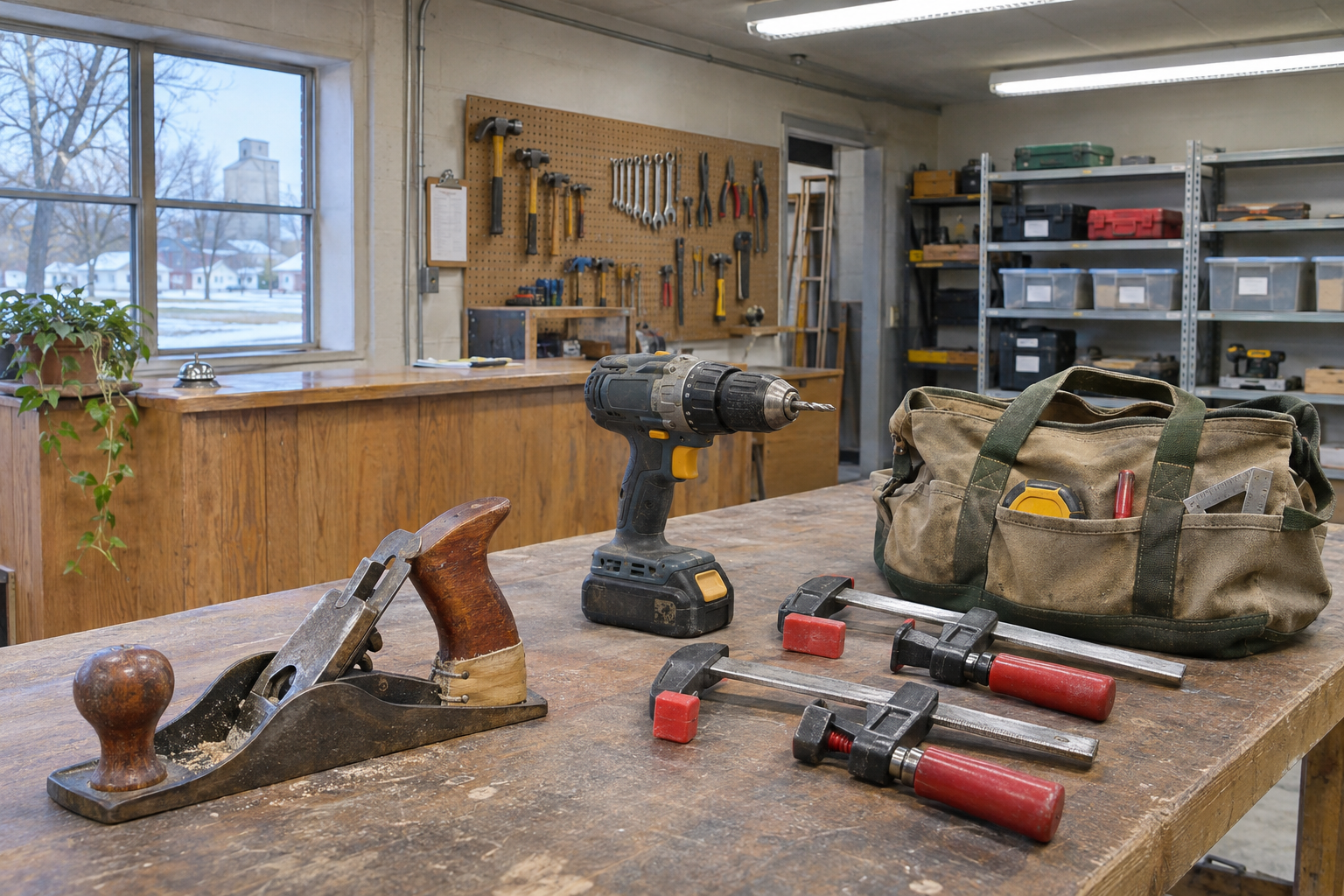
STONECREEK, North Dakota — The town has paused its tool-lending program after 17 returned items arrived with repairs to damage that borrowers said had not occurred. Several of the tools later developed cracks or failures that stopped at the newly added repair, leaving them usable but raising questions about whether they could be lent safely.
The first item was a hand plane returned Thursday by retired teacher Len Cole. Tool-room coordinator Mara Noll noticed a maple wedge fitted into the rear handle and two brass pins crossing the grain. Cole said the handle had been solid when he checked the plane in and that he had neither added the wedge nor taken the tool to a repair shop.
On Friday morning, the handle split while Noll pressed it lightly against the inspection bench. The crack traveled from the base to the first brass pin and stopped. The wedge kept the handle attached. Fresh wood showed along the crack, while the wedge was dry, darkened by oil and worn smooth enough to appear several years old.
Staff then examined 83 items returned during the week. A cordless drill had a replacement trigger dated two months after its purchase receipt, though the original trigger was still operating. When tested, the original contact burned through and the replacement took the load. A folding ladder carried a new aluminum sleeve around a rung that bent inside it during inspection.
Town manager Elise Orr closed the checkout room and contacted 26 current borrowers. She asked them to stop work and return town equipment without testing it. The program serves about 140 households and is used heavily for weatherization, minor plumbing and accessibility repairs; the town waived late fees and arranged rentals for two residents finishing required furnace work.
A competent repair can look older than its surrounding material if salvaged parts are used, said Iva Marr, a machinery instructor who inspected the held items. Hidden damage may also be found and reinforced before a borrower notices it. Marr said those explanations do not account for parts fitted around intact components that failed only after the tool was back in town custody.
No common repairer has been identified. Borrowers collected the tools on different days, used them at addresses across town and signed return slips with no damage noted. Building cameras showed ordinary check-ins. The tools entered the room in bags or cases, and the repairs were visible when each item was first removed at the counter.
The work was practical rather than decorative. A pipe wrench had a new tooth where a worn jaw later chipped. A garden fork carried wire around a tine that broke beneath the wrap. An extension cord had a clean splice six feet from the plug; during an insulation test, the older copper separated at that exact point while the splice remained closed.
Not every added part has been explained by a later failure. A circular saw has a second guard spring, a post-hole digger has a leather binding around one handle, and a canvas tool bag has three rows of stitching beneath an unbroken strap. The town will not stress those items to determine what the repairs anticipate, Orr said.
Staff photographed every tool, logged the unfamiliar materials and moved the held items to an unlocked steel cabinet so batteries could be removed safely. By Monday, the maple wedge and brass pins in the plane still carried old grime, but dust collected from the new crack contained clean maple fibers matching the wedge rather than the original ash handle.
Noll left the checkout counter bare except for a pencil and the return ledger. At closing, she found the pencil fitted with a narrow metal collar just below its unbroken point. She placed it beside the plane without sharpening it. Before she reached the door, the graphite snapped inside the wood and slid forward until the collar caught it.