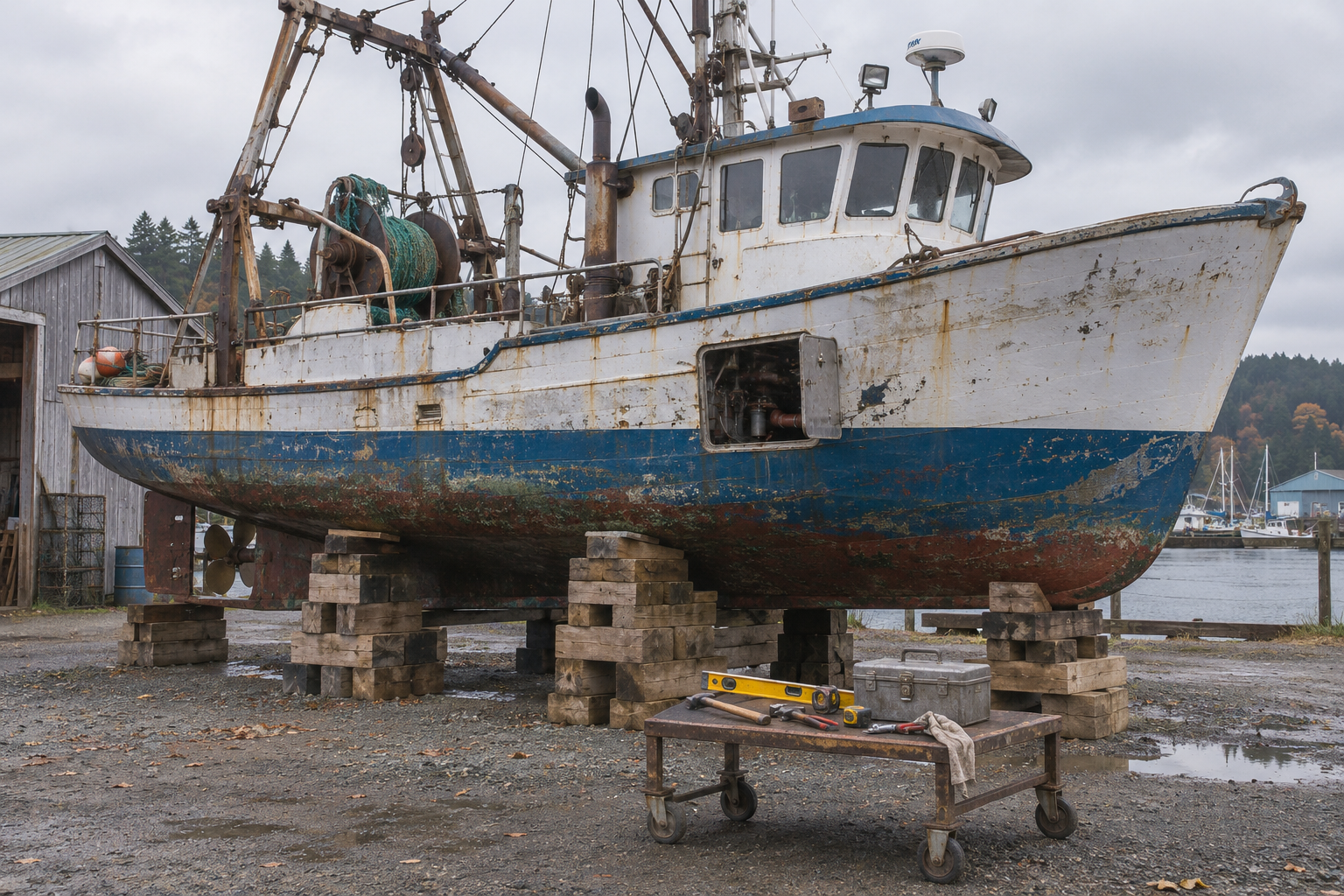
PORT GANNET, Oregon — A commercial boatyard has delayed the relaunch of a 52-foot trawler after loose tools, standing water and suspended plumb lines aboard the dry-docked vessel drew toward the location of a crew berth removed during its refit. The hull remains level on its cribbing, and the yard has closed the boat to everyone except its owner and survey team.
The trawler, built in 1971 and used for groundfish, came out of the water six weeks ago for engine work, new wiring and replacement of two aft bunks. Port Gannet Marine Works planned to return it to the harbor Tuesday. Yard manager Nita Gales postponed the lift after a socket wrench rolled uphill across the galley deck and stopped against the bulkhead where the lower port berth had been.
Carpenter Wes Corbin initially assumed a support block had settled. He checked the deck with two levels and found a slight ordinary slope toward the starboard scupper, opposite the wrench's path. A pencil, three washers and a half-full paper cup then moved toward the port bulkhead. The water surface inside the cup leaned that way even after Corbin held the cup level in his hand.
The removed berth belonged for many seasons to engineer Saul Renn, who retired from fishing in 2019 and died last winter. Captain Inez Roan said Renn chose the lower bunk because engine vibration helped him sleep. The refit plan converts that compartment to dry storage, and the bunk frame was cut apart before the present work began. None of its wood remains aboard.
Roan asked the yard not to reinstall the bunk or treat the movement as a memorial request. She said the boat must be safe for a five-person crew whose weights and sleeping arrangements are already included in its stability plan. Two crew members have taken temporary work on another vessel while the launch is delayed, and the owner is paying the remaining three for shore maintenance.
Marine surveyor Marta Quill inspected the cradle, ballast tanks and bilges. Load cells beneath the support points showed no shift in the vessel's weight, and measurements from the keel to fixed marks in the shed remained constant. Quill said a small deck angle can move a round tool, but it cannot make liquid lean against that angle or draw a plumb bob sideways while its mounting point stays still.
The pull was strongest around objects used in engine work. A clean paintbrush barely turned on the deck, while Renn's old offset wrench slid from a secured tray and crossed the compartment until its handle touched the former bunk location. Roan said the wrench had remained aboard as common equipment and was not kept as a personal item. New tools moved too, though more slowly.
Workers removed unsecured gear and tied the remaining boxes to deck eyes. They also drained rainwater, checked for magnetic fields and disconnected shore power. A brass fastener, a plastic cap and a piece of chalk continued to creep across a dry workbench at roughly an inch per minute. A compass remained steady, and the engine block showed no unusual magnetism.
The yard will conduct an inclining test before deciding whether the trawler can be launched. That test ordinarily shifts known weights across a vessel to calculate stability. Gales said it will be performed with the removed berth compartment empty and no one standing in its line, because the sideways force has varied without warning and has already pulled one rolling toolbox hard enough to bend a wheel lock.
Renn's daughter visited Wednesday and declined Roan's offer to take the old wrench. She said her father disliked the bunk by his last season because he could hear someone breathing beneath it after the engine stopped. He slept in the galley when weather allowed but never asked the owner to alter the boat. His maintenance notebooks contain no entry about the sound.
Before leaving, the survey team stretched a weighted line down the center of the cleared compartment and photographed it from both ends. The line hung straight until the yard's travel lift started outside. It then bent toward the absent berth without swinging, holding a smooth curve for 14 seconds. When the lift shut down, the weight dropped vertically, but a rust-colored mark remained on the painted bulkhead where no metal had touched it.