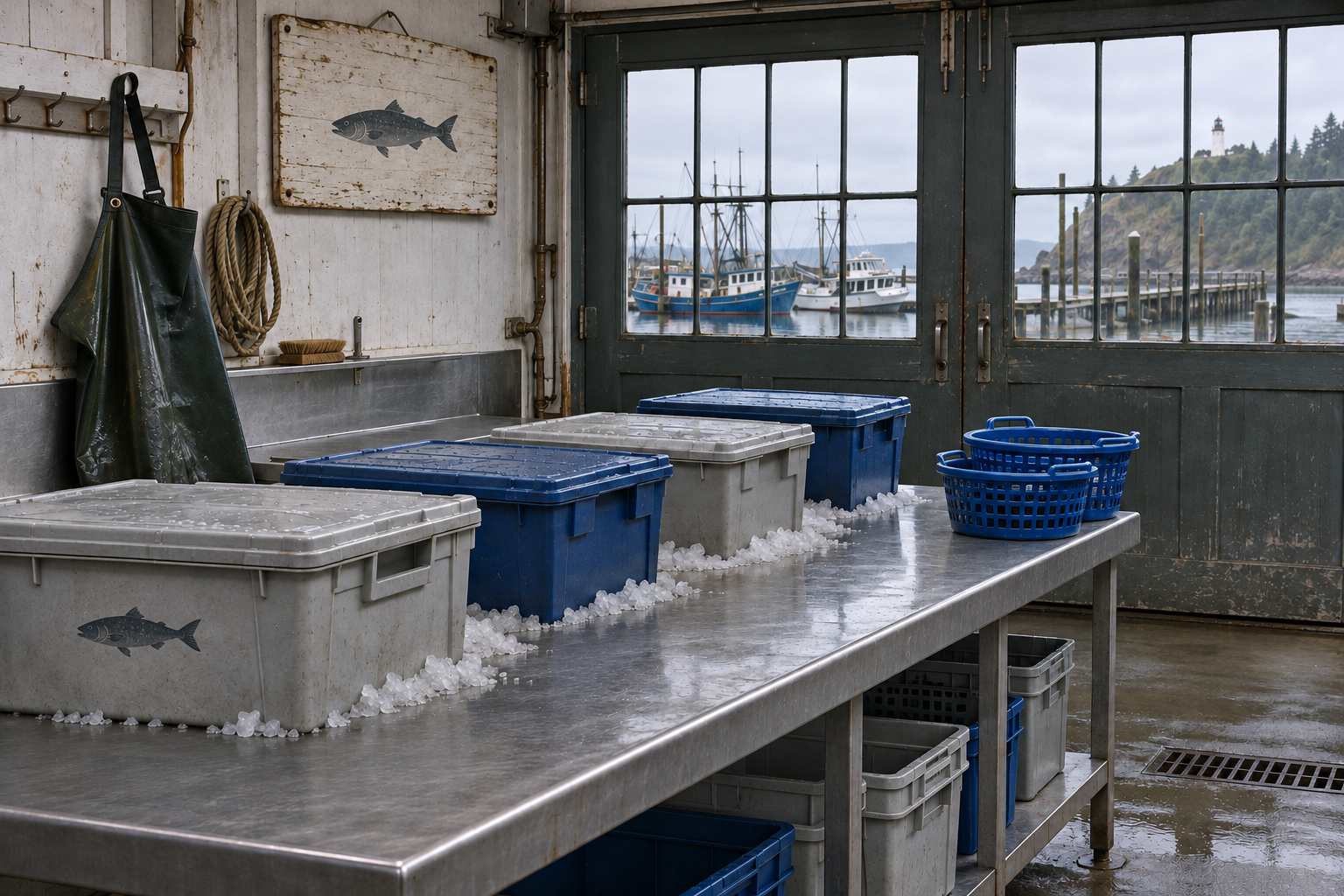
NORTHWICK BAY, Oregon — A fishermen's cooperative has closed its main sorting room after 63 whole rockfish moved across stainless-steel tables and settled into evenly spaced groups more than an hour after landing. Portions separated for quality checks continued changing position inside covered crates, according to workers and a seafood inspector.
The fish were part of a Thursday morning delivery from three hook-and-line boats operating on different grounds. They arrived iced, were weighed and passed routine appearance and temperature checks. Sorter Nessa Marr said the first row shifted while she was recording vessel tags, leaving clean arcs in the crushed ice beneath their tails.
Marr and two coworkers cleared the table, rinsed it and replaced 18 fish in no particular order. Over about seven minutes, the bodies moved in short sideways increments until their heads faced alternating directions and no two touched. Workers did not see fins or mouths move. The table was level, and meltwater continued toward its usual drain.
Cooperative manager Orin Cole stopped processing before any fish from the delivery was filleted or sold. Orders for two restaurants were filled from an earlier lot, and 11 retail customers received refunds. The cooperative closed the room to visitors and moved the affected catch into lidded food-grade crates on fresh ice.
Postmortem muscle contractions can bend a fish, especially during the onset of rigor, said Elise Venn, a seafood biologist who observed the catch. Ice settling, water flow and vibration from refrigeration equipment can also move a body on metal. Venn said those effects would not usually maintain equal spacing or continue through pieces that no longer contain the same muscle groups.
The pattern did not combine the three landings. Fish from each vessel gathered with their own lot even after workers mixed the tags and transferred the bodies between tables. Within those groups, smaller fish occupied the middle. A damaged fish with a missing pectoral fin remained at the outer edge and turned whenever another body shifted near it.
Workers tested the room without adding more catch. Empty trays, rubber weights and sealed bags of ice stayed where they were placed. The table stopped moving when its refrigeration line was shut down, but the fish continued their slow changes as the surface warmed by four degrees. No tremor was recorded at the harbor, and neighboring businesses reported no unusual vibration.
Venn selected one fish under the cooperative's ordinary inspection authority and removed a small section from the tail. The detached section crossed two shallow ice ridges and came to rest beside the fish's cut surface without leaving the meltwater channel. The body had shifted in the opposite direction. Both pieces remained at safe handling temperature.
The county seafood-safety office advised the cooperative to retain the lot rather than distribute it while spoilage and equipment causes are excluded. Cole said the fish will not be offered for food, bait or display. The boats may land Friday at another licensed buyer, and deckhands will be paid from the cooperative's delay fund for the held catch.
By afternoon, the 63 fish were divided among six covered crates. Workers could hear occasional scales scrape plastic but did not reopen them. When Venn lifted one lid at 4:20 p.m., that lot had formed a ring around the crate wall, with a clear patch of ice in the center. Five numbered tags lay together in the open patch.
The room was washed and locked overnight. Friday morning, all six lids were still fastened and the floor was dry except around the drain. There, 63 loose scales formed a narrow line against the normal direction of runoff. The line ended beneath the sealed door of the cold room, where the retained crates remained covered and evenly spaced.