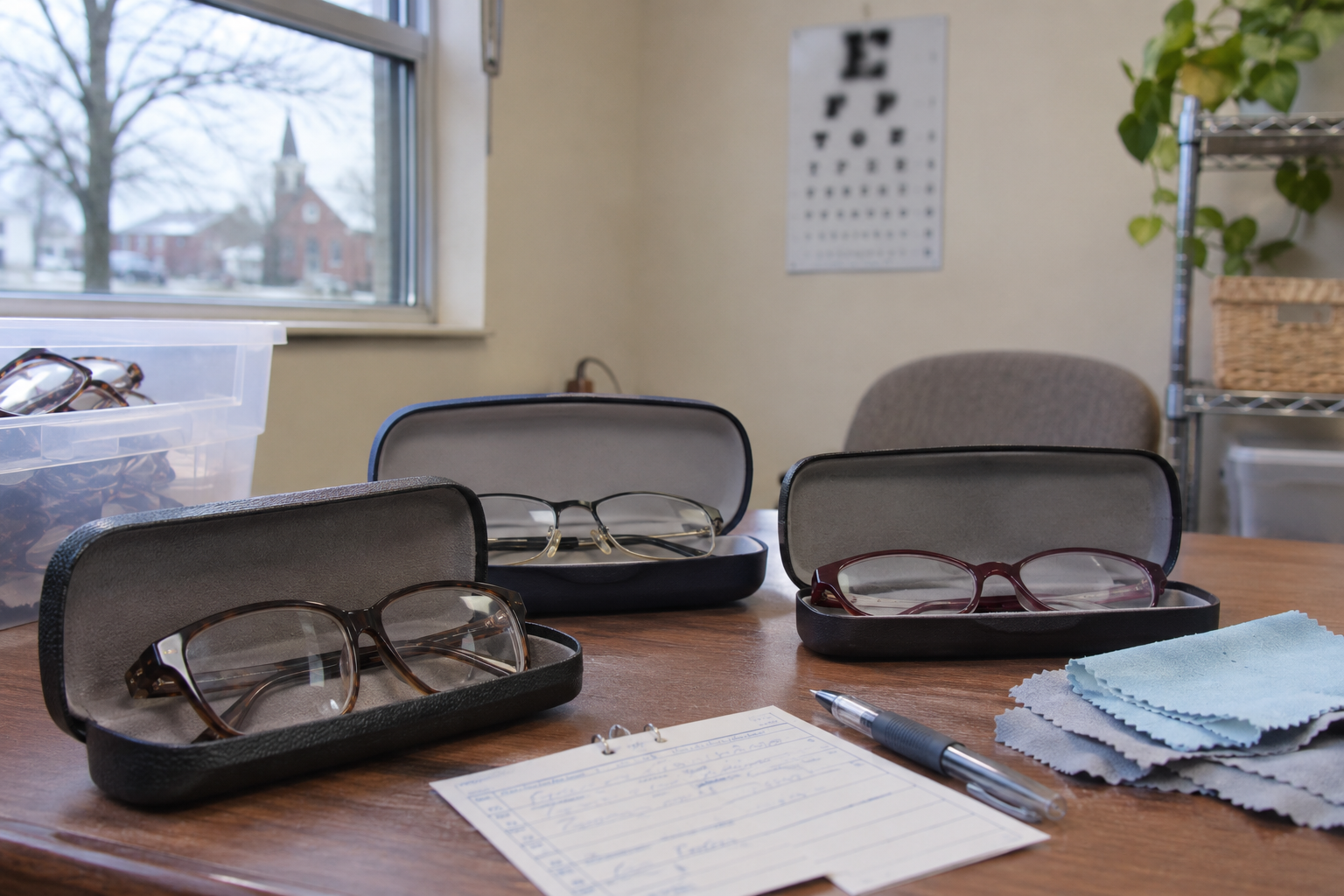
MORROW GLEN, Pennsylvania — A nonprofit vision clinic has paused distribution of donated eyeglasses after patients trying three pairs described brief scenes from the donors' lives while continuing to see the examination room around them. The clinic retained the frames, canceled two fitting appointments and is contacting donors before deciding whether the glasses can be returned.
Morrow Glen Community Vision Clinic collects recent prescription glasses, cleans and measures them and provides suitable pairs to uninsured residents after an eye examination. The affected frames came from separate households and were placed in the same sorting tray Monday. Director Cora Winn said no patient took a pair home and ordinary prescription stock remains available.
The first report came from Louis Trent, a retired roofer who tried a brown plastic frame for distance vision. Trent said the clinic wall remained in front of him, but for several seconds he also saw a yellow kitchen table and a woman cutting apples into a blue bowl. The view appeared through both lenses and ended when he removed the glasses.
Trent did not recognize the room or the woman. The donor, Ruth Calder, later confirmed by telephone that her mother used the glasses before her death and cut apples each morning at a yellow table. Calder supplied a family photograph after Winn asked only about the table color and bowl. Trent had not seen the donor card, which was stored without an address or photograph.
Two other fittings produced different scenes. A grocery clerk saw the inside of a city bus at dusk and felt rain on one sleeve, though her clothing remained dry. A ninth-grade student saw sheet music on a piano and could read four measures despite not reading music. In each account, the clinic room stayed visible and the patients could answer questions normally.
Winn stopped fittings when the student repeated the melody by ear and the donor's son identified it as an exercise his father practiced after a stroke. The clinic covered the three pairs, moved them to a locked cabinet and asked volunteers not to test any donated lenses. Patients who had appointments were offered new examinations or transportation to a partner clinic.
Old prescriptions can distort depth, color and peripheral vision, said Dr. Alina Perrow, an optometrist who examined the frames Tuesday. Reflections, expectation and details glimpsed through an open doorway may also produce vivid associations. Perrow said those effects would not ordinarily provide consistent household details unknown to the wearer or disappear at the frame edge while the present room remained clear.
The scenes did not appear to be recordings that played the same way for everyone. Winn briefly wore the brown frame after Trent's account and saw only blurred shelves. Calder then tried it under supervision and saw her mother's table without the woman seated there. She removed the glasses before the scene ended and asked that the pair not be destroyed.
The clinic's board will review whether consent forms for donations permit returning frames to families. Donated glasses are ordinarily treated as reusable equipment rather than personal records. Winn said the clinic will not ask patients to identify donors, reconstruct private events or wear the glasses for demonstration, even if the prescriptions happen to match.
On Tuesday afternoon, staff measured the lenses again through their paper covers. The prescriptions and scratches were unchanged. A technician found a small crescent of flour inside the hinge of the brown frame, although the glasses had been ultrasonically cleaned Monday. Calder said her mother baked bread at the same kitchen table but had stopped several years before receiving that frame.
The three covered pairs remained in the locked cabinet overnight. When Winn opened it Wednesday, the lens cloth beneath the brown frame was folded into a narrow strip and dusted with flour. A shallow thumbprint crossed the powder beside the case. Calder and Trent had both provided prints for comparison at their own request; the mark matches neither.