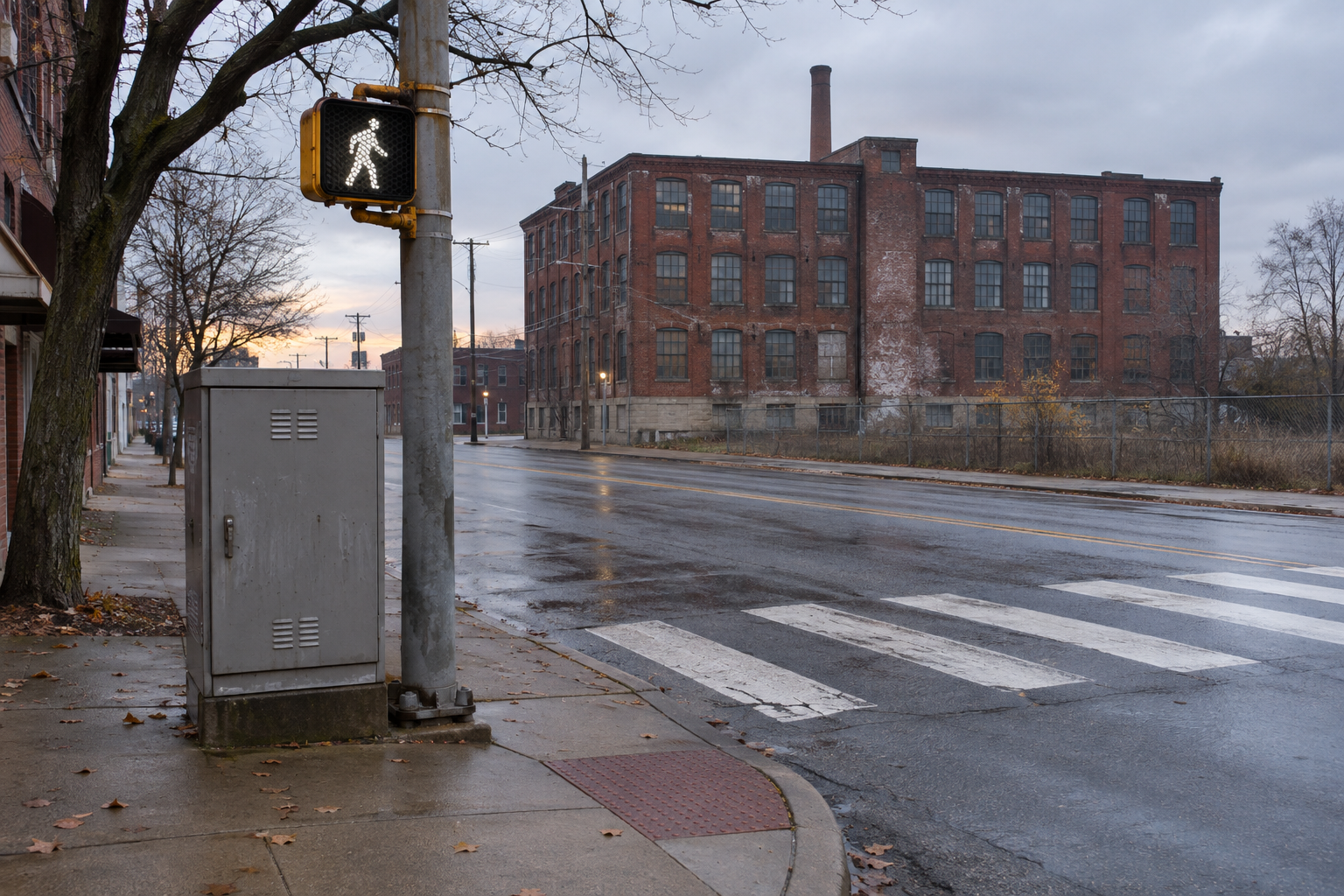
MERCER RUN, Ohio — Mercer Run has placed a downtown pedestrian signal on a fixed overnight cycle after the empty crossing beside the closed Vardon textile mill repeatedly requested a walk phase at 5:42 a.m. Pressure sensors registered a line of separate crossings, although city cameras showed no pedestrians on River Street.
The signal serves a four-lane road between a residential block and the mill's north gate. The plant closed in 2004, and the gate has remained locked since a warehouse company bought the property last year. The city installed accessible push buttons and four curb pads during a repaving project in August.
Traffic technician Iva Cole noticed the requests while reviewing complaints about early-morning delays. For 11 weekdays, the eastbound light turned red at 5:42 and the white walking figure stayed on for 28 seconds. The controller listed between 37 and 52 pedestrians, entered one or two at a time from the neighborhood side.
Cole watched the crossing before dawn Thursday. No one approached, and both push buttons remained dry beneath their hoods. The first curb pad depressed with a load of about 160 pounds, followed by others across the road. A second sequence began before the first reached the mill gate, as it would when a group left a shift together.
The timing was familiar to residents who worked at Vardon. Retired weaver Lena Moss said the first whistle sounded at 5:40, leaving two minutes to cross before the floor opened. She recognized a pause recorded at the center island as the habit of a loom fixer who stopped there to light a cigarette. The man died in 1998, before the present signals were installed.
Public works director Orin Voss changed the overnight signal to a regular two-minute cycle so unverified sensor calls do not stop traffic individually. The adjustment adds no daytime delay. Voss asked people not to gather in the road or place weights on the pads, after several former workers came Friday to watch the 5:42 crossing.
Pressure pads can respond to pooled water, temperature changes or a failed connection, said Mara Kelm, a traffic-control contractor who inspected the cabinet. Kelm found no water intrusion and isolated each pad from the controller. The loads continued to advance across a portable test unit, while sandbags left on the curb registered separately and did not join the sequence.
Not every recorded crossing matched a memory. One load moved back toward the neighborhood halfway across. Another remained on the mill-side pad for 19 minutes. Moss said workers sometimes returned for forgotten badges, but no one would have stood at the locked gate that long during first shift. She stayed until the load disappeared and then went home.
The former workers described the event without agreeing on what it meant. Some called the timing a leftover routine the new equipment had somehow acquired. Others read the list of loads as an attendance count. The mill employed more than 400 people at its peak, and the city has no surviving daily clock cards for its final decade.
Sunday's fixed cycle began at 5:42 with no sensor request. As the walk figure appeared, a row of wet shoe marks formed from the neighborhood curb toward the mill. Most were ordinary work-boot soles. One narrow print stopped at the center island, where a small crescent of fresh ash remained on the wet concrete. The marks beyond it continued to the locked gate and ended with their toes against the chain.
Voss left the fixed schedule in place for Monday and asked the property owner to keep the gate closed during the review. At 5:44, after the signal returned to green, the chain lifted once against the inside of the gate and settled. The controller recorded the waiting load on the mill side but did not request a return crossing.