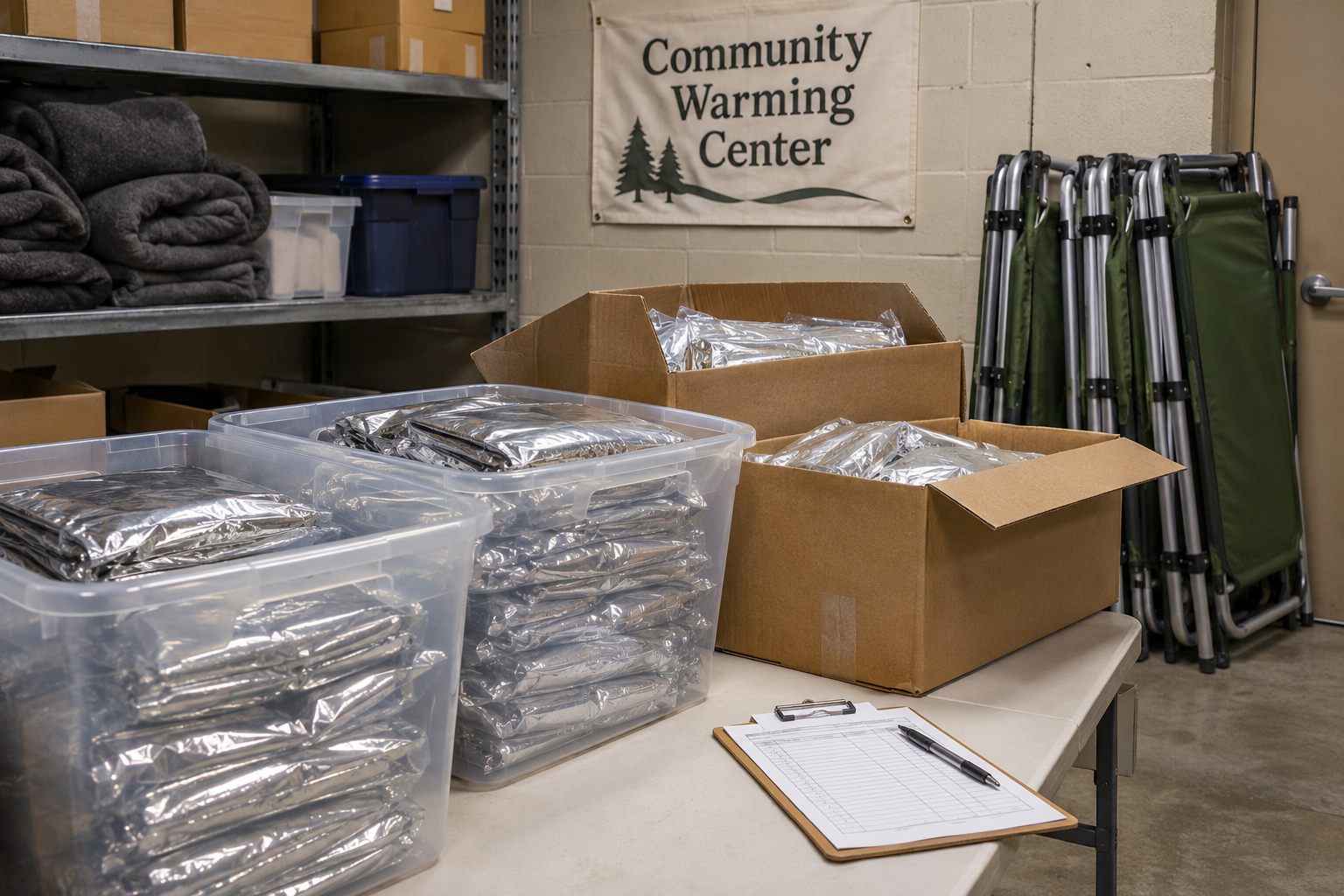
KESTER, North Dakota — Kester has withdrawn 84 sealed emergency blankets from its municipal warming center after stacked packages repeatedly lifted and settled together inside closed storage bins. A county inspector who opened one blanket found wet branching material fused between its reflective layers.
The thin silver blankets were purchased in August as backup supplies for motorists and residents during power outages. They had not been distributed. Volunteers stored them in factory-sealed packages in three clear bins beside folding cots and wool blankets at the former armory, which opens as a warming center when wind chill reaches the town threshold.
Volunteer coordinator Iva Marr observed the first movement during a Friday inventory. The top packages rose about an inch, paused and settled, followed by the packages beneath them. The sequence repeated every six seconds through all three bins. Their lids flexed but remained latched, and no fan or heating equipment was running in the room.
Marr called facilities manager Orin Cole, who moved the bins apart. Each stack continued at the same pace for several minutes, then the packages changed timing until they lifted together. A cardboard box containing the same product from a separate shipping lot began moving on a shelf after Cole entered the room. The wool blankets and folded cots remained still.
Town administrator Lena Voss closed the storage room and obtained replacement blankets from the county emergency warehouse. The warming center can open with its regular bedding and 120 unaffected county units if needed, she said. No resident used the withdrawn supplies, and the town has not advised people to discard ordinary emergency blankets from other purchases.
Air trapped in folded film can shift with temperature or pressure, said Elise Kroll, a county environmental-health inspector. Static charge may also make lightweight packages cling and release in groups. Kroll said the room temperature held at 62 degrees and the movements continued after individual packages were laid flat and punctured to release air.
Kroll opened one package on a metal inspection table. The blanket unfolded to its advertised size but drew its corners inward every few seconds, gathering itself into a shallow oval before flattening again. Beneath the foil coating, thin darker lines divided and rejoined across the center. They did not match the factory's heat-sealed grid.
Using shears, Kroll removed a four-inch square from one corner. The cut edges separated into two reflective skins joined by translucent strands. Clear fluid collected on the table and smelled faintly of wet pennies. When touched with a sampling swab, the strands tightened around the cotton tip and pulled it between the layers.
Kroll sealed the sample and stopped the inspection. The cut blanket continued gathering around the missing corner, each contraction bringing the new edges closer without tearing them. After 20 minutes, the opening had narrowed to a slit edged with soft material the color of uncooked poultry. The reflective skins remained cool and dry on the outside.
Purchase records identify two shipping lots and an established emergency-supply distributor. The cartons were intact, and other town departments received no matching stock. Voss said the town will retain the bins for the county and will seek a refund only after the product and contamination review is complete.
The 84 packages were transferred Saturday to a locked utility trailer behind the armory. Staff arranged them in single layers rather than stacks and marked the floor around each row. At 7 a.m., every package remained within its outline. The cut blanket had folded itself around the sealed sample bag, however, and the silver surface above it rose and fell once whenever condensation reached the trailer roof.