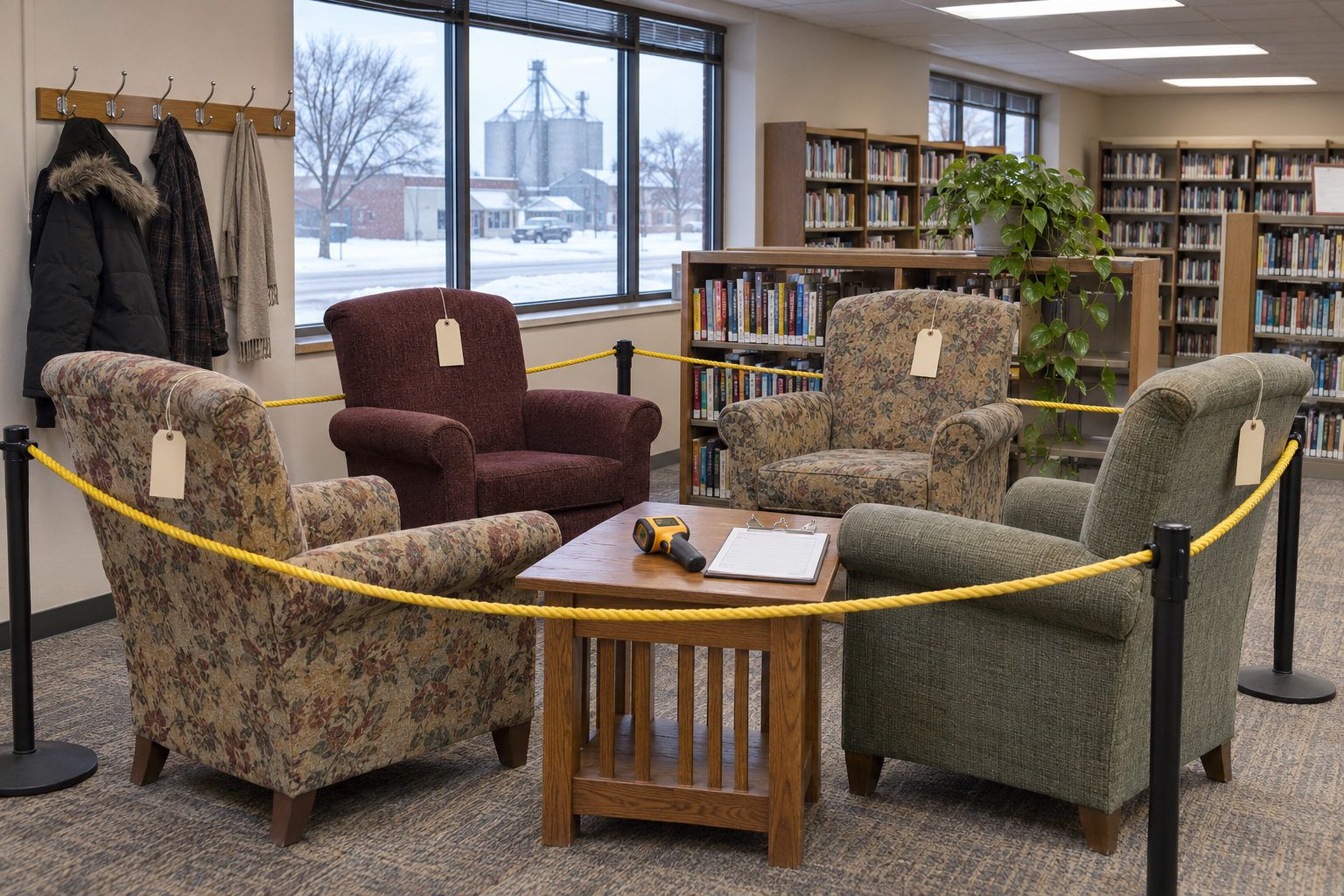
HARROW, North Dakota — Harrow Public Library has removed four donated reading chairs after patrons reported that chronic pain eased while they sat in them and returned when they stood. Staff also found warm, rigid areas in the upholstery corresponding to the locations of the reported symptoms, although the chairs contain no heaters or powered components.
The chairs were donated in October by a bank that remodeled its lobby. They were cleaned by a commercial contractor and placed near the library's west windows last week. Librarian Elise Rusk noticed the first concern when a patron with arthritis remained in one chair through closing and said her hands no longer hurt enough to prevent her from turning pages.
The relief ended several minutes after the patron stood. Rusk then found two small warm patches on the chair arms where the woman's hands had rested. An infrared thermometer measured 99 degrees at those spots while the rest of the fabric was 68 degrees. The patches cooled over the next hour and left the padding slightly harder.
Other patrons reported different effects. A retired mechanic said his lower-back pain disappeared in a green chair while a firm ridge formed behind its lumbar cushion. A teenager recovering from a sprained ankle felt no pain until she reached the circulation desk; staff later found the chair's front corner swollen beneath the upholstery near where her foot had rested.
Library director Nessa Cole closed the reading corner Monday after word of the chairs brought 19 additional visitors, including several people who asked to reserve a seat for medical reasons. The library canceled those reservations and moved ordinary wooden chairs into the area. Cole said staff cannot offer or advertise a treatment and will not ask anyone to reproduce a symptom for inspection.
Pressure, posture, warmth and attention can change how pain is perceived for a short period, said Dr. Lena Marr, a rehabilitation physician who reviewed the library's incident notes. A supportive chair may reduce strain, and expectation can alter reported intensity. Marr said those effects would not normally create lasting hot spots or new densities in foam after the person leaves.
An upholsterer removed the dust covers without cutting the fabric. The chair frames and springs were sound, and no heat packs, wires or chemical containers were present. Foam beneath the warm areas had narrowed into pale, compact bands. In the green chair, one band followed the curve of a healed surgical scar shown in the mechanic's medical photograph.
The patrons did not leave their conditions entirely behind. Pain returned at its prior level in five accounts and somewhat lower in two. The woman with arthritis said her fingers remained easier to move through the evening. She asked whether the chair could be kept available under supervision; the library declined but offered home-delivery service while the review continues.
The chairs behaved differently when empty. Staff heard an occasional spring shift and recorded brief surface temperatures between 96 and 101 degrees. The locations changed from the chair arms to the lower backs and seats, matching no heating vent or patch of sunlight. A wooden chair placed among them remained at room temperature.
Cole moved the four chairs into the meeting room, attached inspection tags and left the door unlocked for fire access. On Tuesday morning, their cushions showed shallow impressions corresponding to four people seated at different heights. Security video showed no entry after closing, and the impressions slowly lifted after the building opened.
One impression did not lift. It remains in the green chair as a narrow hollow along the lower cushion, where the mechanic's back had rested. The man told staff his pain did not return Tuesday morning for the first time in 11 years. When the chair was carried into storage, its wooden legs dragged unevenly because the hollow side had become 14 pounds heavier than the other.