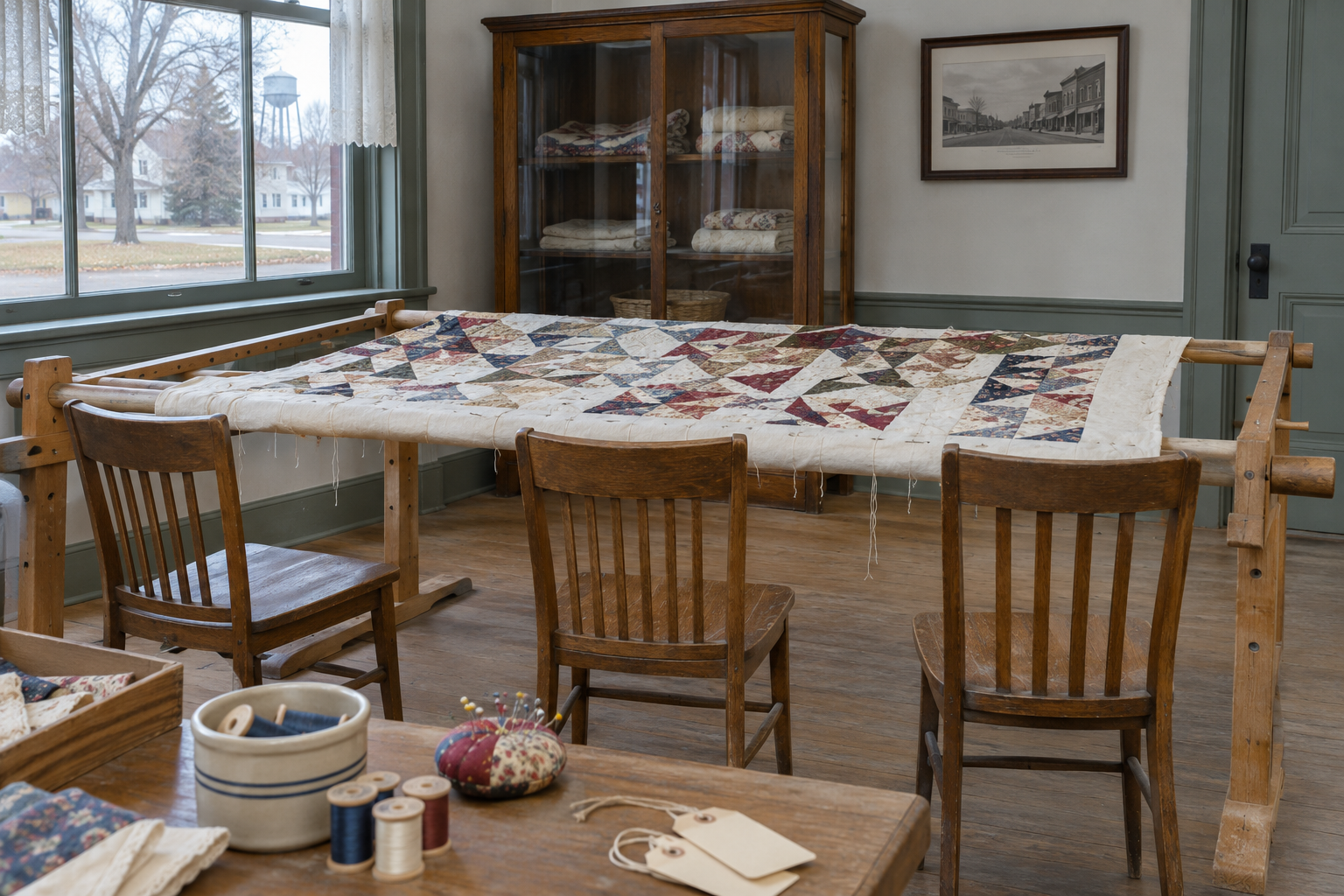
GULL LAKE, Minnesota — The Gull Lake Historical Society has paused volunteer work on an unfinished quilt after six people reported sewing it in the same dream and staff found new stitches on the frame the following mornings. The society has postponed the quilt's winter exhibition and closed its textile room while a conservator documents the added work.
The quilt was donated in August from the estate of school secretary Ruth Danner, who died in 2024. Its 42 pieced blocks were complete, but broad sections of the cream border had never been quilted. The society mounted it on a frame last month so volunteers could finish those sections during public work sessions.
Volunteer Mara Kroll reported the first dream Thursday after sewing at the frame that afternoon. She remembered working in a narrow room with covered windows, a coal stove and four other people whose faces she could not see. A woman behind her counted stitches in groups of seven. Kroll woke with a tender spot on her right index finger but no broken skin.
When textile coordinator Lena Orr opened the society at 9 a.m., she found two completed rows in the border where Kroll had stopped. The room had been locked, its street-facing window was latched and the building alarm showed no entry. Orr initially assumed another volunteer had continued without signing the work log.
Three more volunteers described the narrow room after Friday's session. Orr collected their accounts separately before allowing them to speak together. All placed the stove to their left and a low shelf behind the frame. Two remembered rain at the covered windows, while another said the sound came from dry beans being sorted into a pan.
The society suspended public sewing Saturday and notified the estate's representative. The delay affects a planned Nov. 28 opening and a school visit. Director Iva Moss said the quilt will remain on the premises because its ownership is settled and its condition is stable, but no additional work will be accepted until every recent stitch is mapped.
Vivid dreams can incorporate repetitive handwork, room details and comments heard during the day, said Dr. Soren Bell, a sleep clinician who reviewed anonymized statements for the society. People working together may also describe similar settings because they share expectations about older domestic labor. Bell said those factors would not account for changes to a locked textile or matching fingertip soreness among people who did not sew the same section.
Conservator Elise Venn found that the added rows were made with cotton thread from three open spools beside the frame. Their stitch lengths varied in recurring bands. Kroll identified one band as her own habit of shortening every fifth stitch near a seam; another volunteer recognized the uneven backstitch she uses when turning a corner.
Danner's family has no photograph of the room the volunteers described. Her niece said Danner learned to quilt at home in a bright kitchen and did not own a coal stove. The society's accession packet contains one older note stating that the border was 'left for the table,' but it does not name a group or explain why the work stopped.
On Monday, Orr removed the needles, counted the spools and covered the frame with unbleached cloth. The building remained closed overnight. Tuesday morning, the cover was still tied, but nine feet of border beneath it had been stitched. The loose thread passed through the quilt from three directions and met in one knot on the backing.
The conservator left that knot intact and placed the quilt under a clear dust cover. No volunteer reported a dream Tuesday night. On Wednesday, five chairs stood around the frame although staff had put away four. The additional chair was a smaller maple chair from the society's classroom, and its seat held a pincushion containing six needles, one for each volunteer who had already given a statement.