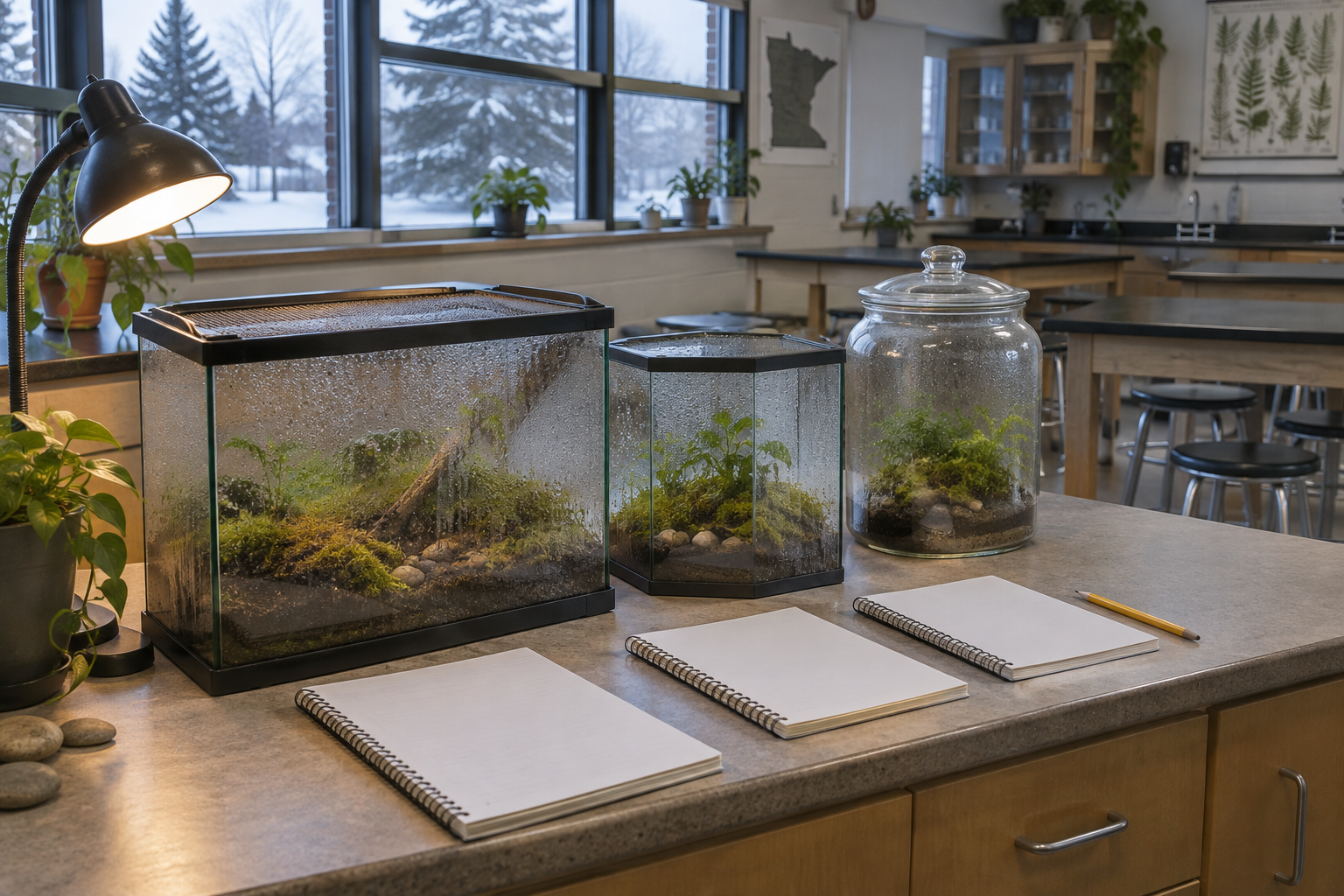
EAST VARDA, Minnesota — East Varda Middle School has moved two biology classes to the library after three classroom terrariums began forming scenes students recognized from dreams they had the previous night. The changes involved condensation, soil and plant growth inside closed glass containers; no animals are kept in them.
Seventh-grade students built the terrariums in September to study water cycles. Each contains local moss, potting soil, stones and a small fern under a fitted lid. Students record moisture and growth twice a week, and the containers had shown only gradual changes until a class arrived Thursday morning.
Science teacher Nessa Bell found the largest terrarium divided by a narrow ridge of soil with a pale stone at one end. Student Iva Wynn said it matched a dream in which she crossed a railroad embankment to reach a white house. She had described the dream to her mother at breakfast but had not discussed it at school.
A second container held a clear oval in its condensation, surrounded by finger-width streaks. Three students separately recognized a frozen pond from a shared dream, although they placed different people on the far shore. The glass was wet on the inside and unmarked outside. Bell photographed the containers before anyone opened a notebook.
Principal Mara Cole closed the room and asked families not to question children for additional details. The affected classes are continuing their regular unit in the library with printed diagrams. Cole said dream accounts are private and will not be graded, collected as an assignment or used to decide whether a student may enter the classroom.
Condensation patterns respond to temperature, fingerprints and slight differences in the glass, said Elise Marr, a plant ecologist who inspected the room. Moss and fern fronds can also shift toward light during the night. Marr said those ordinary changes may invite people to see familiar scenes, but one container's soil ridge had crossed beneath two rooted plants without disturbing them.
Students did not agree about every image. Several saw only wet glass and moss. Others recognized a stairwell, a field of black birds or a bedroom ceiling. In one case, two friends claimed the same arrangement but disagreed over whether the tiny fern represented a person leaving or returning. Bell recorded only the physical changes and did not settle the interpretation.
The scenes affected the class in different ways. Wynn asked to take the pale stone home and accepted the school's refusal. Another student felt relieved to see that a recurring dream ended at the edge of the glass rather than continuing. A third stopped describing his scene after noticing a bare patch of soil that he said belonged behind a closed door.
Facilities staff checked door logs and overnight video. No one entered the classroom after the custodian left at 6:18 p.m. The lids remained seated, and thread placed across each rim Friday was intact Saturday morning. A terrarium kept in the library under the same lamp formed ordinary condensation and no new ridges.
Bell asked families to note only whether students slept, not what they dreamed. After a night when four students reported poor sleep, the containers changed little. The next morning, moss in all three had flattened into parallel bands. Six students independently said they had dreamed of riding in a dark bus, but none remembered a destination.
The school left the classroom empty Sunday night. At 7 a.m. Monday, the glass was clear except for three narrow ovals at student eye level. Inside, the ferns had turned toward the counter rather than the windows. Seen through the aligned stems, the empty stools appeared occupied by dark shapes made only from overlapping leaves; when staff moved sideways, the shapes remained seated.