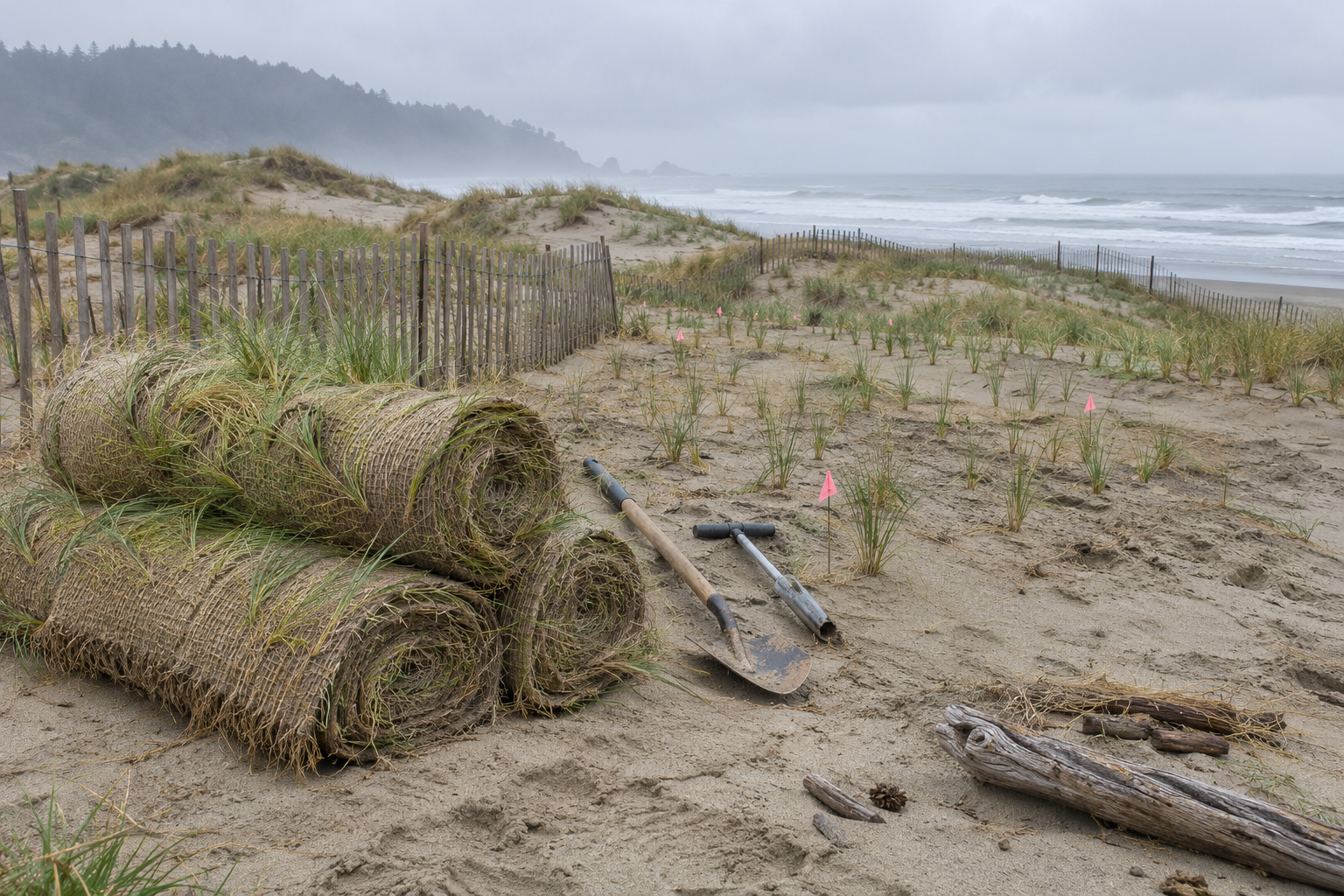
BRIER COVE, Oregon — The Brier Cove Dune District has paused beach-grass planting after rolled root mats repeatedly turned and extended roots toward small pieces of buried debris. Crews have left 11 prepared plots open while biologists inspect the plants and determine whether the objects should remain in place.
The district is rebuilding a low dune damaged by October surf. Workers place sections of native dune grass in shallow trenches, stake them and cover the roots with sand. Crew leader Nessa Cole noticed Friday that three unstaked sections had rotated overnight, leaving curved drag marks around their original planting holes.
Each mat faced a different point beneath the dune. Workers dug along the root tips and found a rusted thimble, a piece of green bottle glass and a child's red plastic comb between 8 and 14 inches below the surface. The roots had grown several inches through dry sand and divided around each object without attaching to it.
Crews removed the debris and reset the grass. By Saturday morning, the three mats had turned toward the district's storage tray, where the objects had been bagged. Two newly installed sections also leaned out of their stakes. Excavation beneath them uncovered a brass cabinet pull and a smooth black stone wrapped in fishing line.
District manager Mara Voss stopped planting and fenced the work area. The delay affects about 260 feet of dune scheduled for completion before winter storms. Existing vegetation remains stable, and public beach access is open at the south path, though volunteers were asked not to dig for additional objects or move flagged plants.
Beach grasses send roots toward moisture, nutrients and areas of lower soil resistance, said Len Marr, a restoration botanist who inspected the site. Wind can push an unsecured mat, and buried debris may collect condensation or organic material. Marr said the recovered items were dry and chemically different, while the roots showed the same response to each.
The plants were grown at two nurseries and delivered in separate loads. Both lots turned. Root samples showed ordinary new growth with no visible fungus, insect damage or grafting. Sand moisture varied little across the plots, and buried clean glass, steel washers and plastic tags placed by the district drew no roots during an overnight check.
The weathered objects appear unrelated. The thimble is machine-made and likely less than a century old. The comb was sold widely in the 1980s, while the bottle glass has rounded edges consistent with long exposure to surf. The district has not treated the items as archaeological material but is recording their locations before disposal.
One volunteer, Iva Rusk, recognized the cabinet pull as similar to hardware from a rental cottage removed after a 1996 storm. She could not identify the individual piece. A district map places that cottage more than half a mile north of the restoration site, and the dune between the two has been graded at least twice.
Staff moved eight unused mats into separate tubs inside a locked equipment shed. Six remained flat. The other two pressed their root ends against the northwest walls of their tubs, aligned with a locker holding the bagged debris. When the bags were carried to the opposite end of the shed, fine roots changed direction over three hours without shifting the grass above them.
The district returned the bags to the locker and left the two mats in place for observation. Tuesday morning, roots had entered the locker through its lower ventilation slots and woven through all five bags. Each object remained loose inside its plastic. The empty sixth bag, kept for additional finds, had no roots around it.