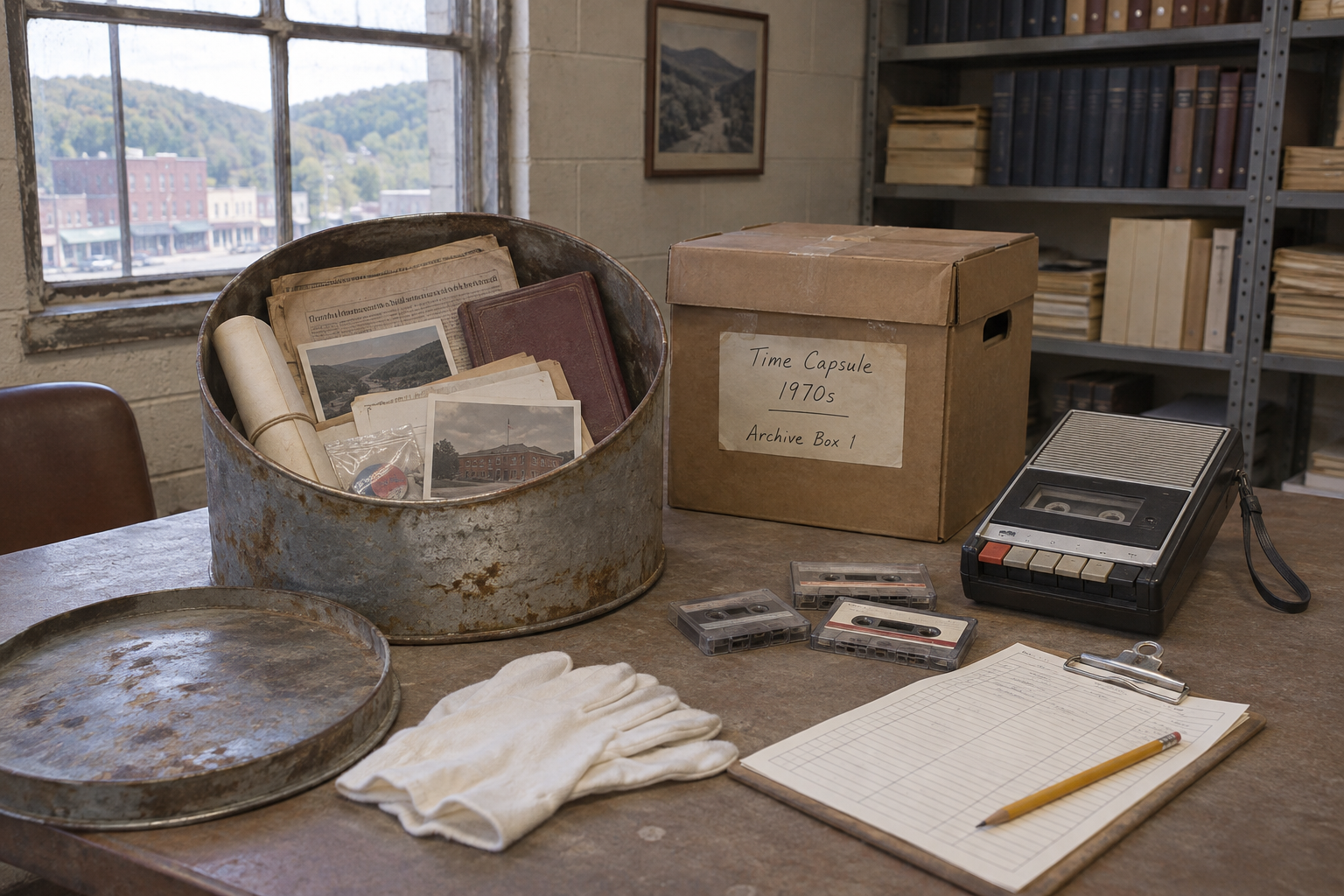
SAYER, West Virginia — Beckett County has delayed a public exhibit of its 1976 bicentennial time capsule after four cassette tapes played answers in the voices of people listening to them rather than the residents interviewed on the labels. Three listeners also found that, for several hours, they could not repeat particular sentences heard on the recordings.
The capsule was removed last week from a cornerstone at the former county services building, which is being converted into a senior center. Its contents include newspapers, employee badges, seed packets, photographs and seven half-hour cassettes made by the county historical committee. The exhibit was scheduled to open Saturday in the courthouse annex.
Records clerk Lena Moss encountered the first change while checking a tape labeled "A WORKDAY IN 1976." A retired telephone operator described connecting long-distance calls and then asked, "What work will you do when this is opened?" In the six-second pause that followed, Moss heard herself answer that she would be indexing deeds. She had not spoken in the room.
Moss stopped the player and called assistant clerk Orin Voss to the table. When they restarted the tape, the operator's question was followed by Voss's voice saying he expected to be repairing a porch roof. Voss had planned that work for the weekend but had not mentioned it at the annex. Moss's earlier answer was no longer present.
County administrator Elise Wynn closed the inventory room, postponed the exhibit and asked the historical society to provide a second playback machine. The records office remains open, but the tapes are being handled only by two clerks at a time. Wynn said the county will display the ordinary capsule contents once their condition and ownership are documented, even if the audio review takes longer.
Old magnetic tape can hold previous recordings beneath a newer track, and a poorly shielded player may pick up radio or electrical noise, said Mara Kelm, an audio conservator retained by the county. Print-through can also produce faint advance echoes. Kelm said those faults do not ordinarily create a current listener's voice or replace one answer with another between playbacks.
The responses were brief and ordinary. A maintenance employee heard himself say that he had forgotten pears in his truck. A historical society volunteer answered a question about future clothing by describing the blue coat she was wearing. On another tape, a clerk's voice named the lunch packed in a closed paper bag beneath her desk.
After listening, Moss tried to tell Wynn what she had heard. She could say that she worked with land records, but the phrase "I index deeds" produced no sound despite visible movement in her throat and mouth. Voss could discuss repairs but could not say "porch roof." Both could write the phrases. Their voices returned during the afternoon without pain, numbness or other symptoms.
Kelm removed the cassettes from the county's player and found their housings intact, with no added splices or secondary tape. A test cassette recorded in the room played normally. The four affected tapes did not respond to questions spoken by staff; they only answered questions already asked by the 1976 interviewers, using the voice of whichever listener sat nearest the machine.
The original committee left a typed index naming 12 interview subjects. Nine have died, two live outside the county and one could not be located. Surviving relatives who reviewed transcripts recognized the interviewers' words but not the inserted answers. The county will provide digital copies after the speakers' identities and consent questions are resolved.
On Wednesday, Kelm placed the four cassettes in separate archival cases without playing them again. While she completed the condition report, the unplugged recorder advanced 11 seconds and stopped. Its counter window was the only moving part. Playback of that section later produced the sound of inventory pages turning, followed by Vale's voice saying, "Leave the last line blank." I had not yet arrived at the annex, and the condition report's last line remains unused.